
Imagine this: The power is out. The gas lines are shut off. You have a bag of rice and a pot of water, but no way to boil it. Your electric range is a paperweight, and an open campfire in your backyard is a beacon for everyone within a mile radius.
You don’t need expensive gear. You need physics.
In Chapter 7 of Survive From The Pantry, we introduce the ultimate hack for off-grid cooking: The Rocket Stove. It’s not just a fire inside a box; it is a hyper-efficient combustion engine that you can build in 30 seconds using debris you probably already have in your yard.
The Science: The “J-Curve” Effect
A Rocket Stove relies on a specific engineering design known as the “J-tube” combustion chamber. Unlike a campfire, where heat disperses in all directions (mostly wasted), a rocket stove forces heat through a narrow, insulated vertical tunnel.
Look at the diagram below. This isn’t magic; it’s fluid dynamics.
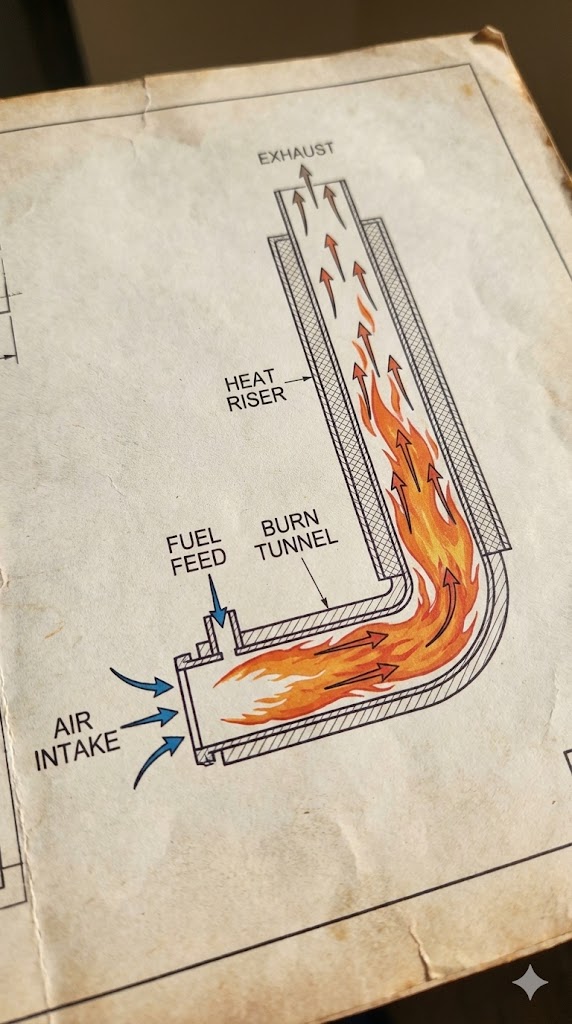
(Caption: The anatomy of a Rocket Stove. Note the “Burn Tunnel” where fuel meets oxygen, and the “Heat Riser” that creates the draft.)
This design accomplishes two critical things:
1. The Stack Effect (The Draft) As the fire burns in the horizontal “Burn Tunnel,” the heat transitions into the vertical “Heat Riser.” Hot air is less dense, so it shoots upward. This creates a powerful vacuum at the bottom (the intake), sucking in massive amounts of fresh oxygen. This “forced induction” feeds the fire, making it burn hotter and faster than a natural flame.
2. Complete Combustion (No Smoke) Smoke is actually just unburnt fuel (particulates). Because the Rocket Stove creates such intense heat within the insulated riser, it achieves “secondary combustion.” It burns the wood, and then it burns the smoke itself.
- Result: You get a smokeless flame that reaches temperatures of 1,000°F+ using nothing but twigs.
Why It Beats a Campfire (Every Time)
- Fuel Efficiency: You don’t need logs. You don’t need an axe. A Rocket Stove runs on “biomass debris”—twigs, pinecones, dried stalks, and broken sticks. You can boil a liter of water with a handful of fuel that fits in your pocket.
- Stealth (Light Discipline): In a survival scenario, smoke attracts attention. A properly tuned rocket stove is virtually smokeless and produces almost no visible light signature from a distance because the flame is contained within the chimney.
- Speed: It directs 100% of the thermal energy to the bottom of your pot. It boils water faster than many residential gas stovetops.
The “30-Second” Build: The 4-Block Method
You can build complex rocket stoves out of metal buckets and perlite, but in an emergency, you need the Cinder Block (CMU) Method.
What you need:
- 4 Concrete Cinder Blocks (Standard size).
- No mortar. No cement. Just gravity.
The Assembly:
- The Base: Lay the first block flat on the ground (open ends facing up). This is your foundation.
- The Intake: Place the second block on top, standing vertically. Pro Tip: You need to break out the front face of this block to create the “J” intake, OR simply arrange bricks to form a tunnel leading into the chimney.
- The Chimney: Stack the remaining blocks to form the vertical riser. Align the holes so you have a clear vertical shaft from the bottom to the top.
- The Pot Stand: Do not place your pot directly on the top hole—you will choke the fire! Put two small rocks or a metal grate on top to allow airflow to escape around the pot.
Safety Protocols: Respect the Heat
Just because it’s efficient doesn’t mean it’s harmless. Follow these rules to keep your eyebrows (and your house) intact.
- ⚠️ The Carbon Monoxide Rule: NEVER use this indoors. Even though it burns “clean,” it consumes oxygen and releases CO. This is an outdoor-only tool. Ideally, use it on a concrete patio or bare dirt.
- Thermal Mass: Cinder blocks and bricks act as thermal batteries. They will stay dangerously hot for hours after the fire is out. Do not attempt to dismantle the stove until it is cool to the touch.
- Stability: Rocket stoves are tall and narrow. Ensure your base is level. A tipped-over pot of boiling water is a medical disaster you cannot afford when hospitals are closed.
Build it now. Practice often. Eat hot food when the grid fails.
— Protocol Redwood