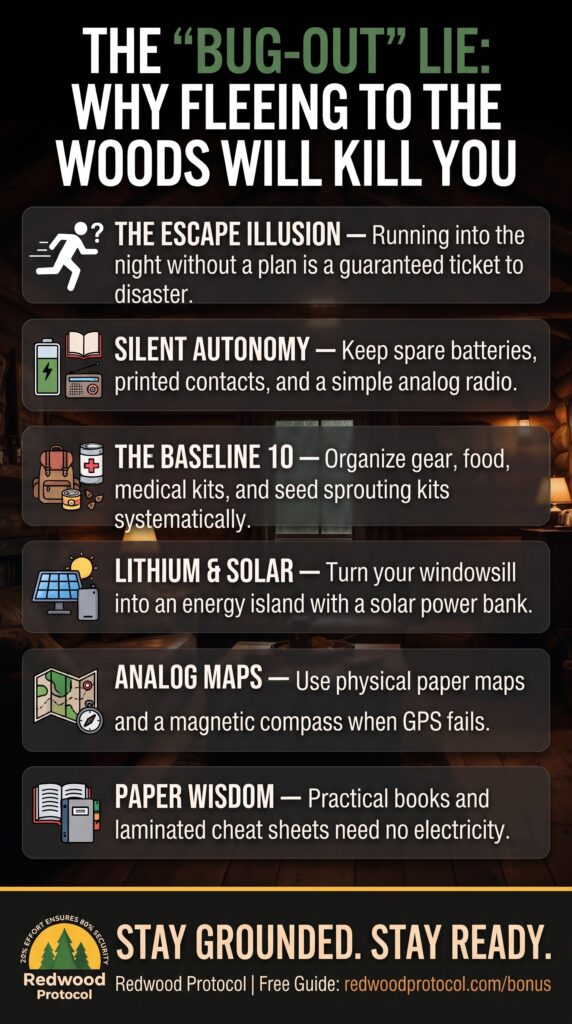
When modern culture imagines an emergency, it defaults to cinematic fiction: empty highways, roving chaos, thousands of dollars spent on tactical gear, and running blindly into the dark night. Yet in the real world, crises strike quietly, directly inside your domestic perimeter. A sudden winter ice storm takes down the regional power grid, or a grid-down blackout leaves your household without power for weeks.
What happens next inside the typical pantry? Panic, spoiled refrigerated food, and heavy, energy-draining rations that destroy family digestion. Running away from home without a sober plan is a guaranteed ticket to disaster. Your house is your only true, unbreakable fortress.
1. The Escape Illusion & Hollywood Mirages
For decades, Hollywood has forced template scenarios on us: either a panicked escape into the unknown with Rambo-like skills, or multi-thousand-dollar investments in elite bunkers. There is zero chance for an ordinary family in these cinematic sets. Yet they are the absolute majority.
And the bitter truth is that this majority doesn’t need thousands of dollars or military gear. All these imposed fears are just marketing. Running “into the night” is a guaranteed ticket to the afterlife. Just two hundred dollars, wisely invested in basic items from a regular supermarket and backed by a sober plan, is enough. This will give you vastly more protection than any expensive blockbuster. Forget abstract calorie charts.
The Contrast: Home vs. Wilderness Under Stress
- The Home Environment: Controlled micro-climate, familiar spatial orientation, structural thermal mass, and secured access points.
- The Wilderness Escape: Uncontrolled exposure, physical exhaustion, acute hypothermia risks, and total absence of medical infrastructure.
2. Infrastructure of Silence — Light, Power, and Gear
When the hum of the familiar world dies down and communication networks snap, your home faces a loss of light and connectivity. Most people blindly rely on smartphones, forgetting that without electricity a pocket screen turns into a useless piece of glass.
The first level of defense is silent autonomy. Spare batteries, printed emergency contacts on paper, and a simple analog radio. Tune it to a local wave, and you’ll know the situation without putting yourself at risk on the streets. Today, you can order game-changing gear: a 3-in-1 combo device featuring a radio, LED flashlight, and mini solar panel with a hand crank, backed up by a lithium power bank and a foldable solar panel (21–30W).
3. The Baseline 10: Essential Gear & Biological Sufficiency
To build an unbreakable domestic foundation, your inventory must be systematically organized. The following comprehensive matrix outlines the core components required for a multi-week grid-down scenario.
| Category / Item | Tactical Purpose & Function | Maintenance & Deployment Protocol |
| 1. Strategic Food & Water | Multi-day family supply of high-density staples (canned goods, rice, legumes) for baseline caloric intake. | Store in dark, climate-controlled areas; rotate stock systematically on a FIFO (First-In, First-Out) basis. |
| 2. Sprouting Seed Kit | Living nutrition (green lentils, red radish, broccoli sprouts) providing active enzymes and vitamins during long crises. | Grow in compact trays indoors using minimal water; harvests ready within 3 to 5 days without soil. |
| 3. Fire & Light Sources | Waterproof LED flashlights, quality candles, waterproof matches, and ferro rods to dispel darkness and maintain morale. | Keep dry in sealed containers; distribute across different rooms to prevent single-point loss. |
| 4. 3-in-1 Combo Device | Integrated gadget combining an emergency radio, LED flashlight, hand-crank dynamo, and mini solar panel. | Test mechanical crank and solar charging capabilities monthly to prevent battery sulfation. |
| 5. Dedicated Analog Radio | Classic battery-operated or simple non-smart radio for receiving emergency broadcasts without digital interference. | Store with a dedicated bulk supply of sealed alkaline or lithium batteries in an EMP-safe container. |
| 6. Lithium Power Station | Robust portable power bank paired with a 21–30W folding monocrystalline solar panel for localized recharging. | Position solar panels on windowsills during daylight hours; protect units from freezing temperatures. |
| 7. Advanced Medical Kit | Core trauma supplies, prescription medications, burn gels, heavy-duty bandages, and broad-spectrum antiseptics. | Audit expiration dates bi-annually; ensure all family members know the location of emergency medical packs. |
| 8. Documents & Stationery | Protected personal papers in heavy-duty zip-lock bags, small cash bills, pencils, and waterproof markers. | Never rely on digital storage for essential property titles, medical histories, or routing maps. |
| 9. Laminated Cheat Sheets | Water-resistant reference cards detailing water purification steps, first aid protocols, and communication schedules. | Place near primary water filtration and medical stations for rapid reference under high-stress conditions. |
| 10. Analog Maps & Compass | Detailed regional and city paper maps paired with a reliable baseplate magnetic compass for off-grid routing. | Pre-mark primary and secondary evacuation routes using waterproof ink before any crisis strikes. |
4. Paper Wisdom and Quiet Finale
And finally, one more thing we so often forget in the era of digital clouds. We are used to storing everything in smartphone memories. But what happens when screens go dark? The answer is simple: true, time-tested wisdom always lives on paper.
Having a good practical survival and homesteading book at hand isn’t an old-fashioned whim—it’s real insurance. A book needs no charging, feels no electromagnetic pulses, and is always ready to offer the right solution in a critical moment.
If you want to deepen your knowledge and build a reliable security system for your family without panic or million-dollar costs, explore the official blueprints and field guides.