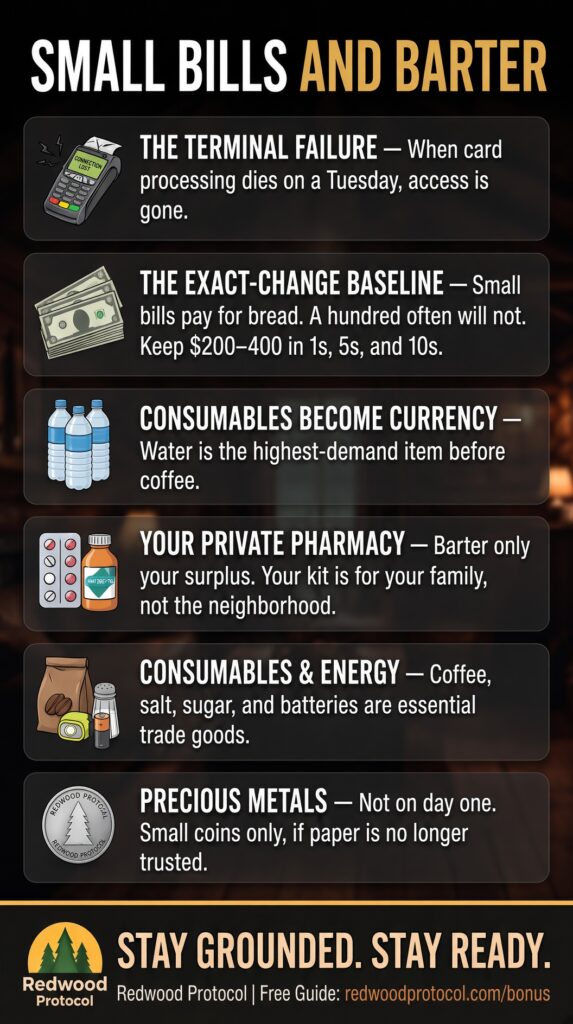
Picture this: It’s a standard Tuesday evening, and you’re standing in line at the grocery store. The register hums, the belt moves, and you tap your card against the reader. A split second later, the terminal beeps flatly: “Connection Lost / Payment Declined.” You try your phone. Same result. The cashier pauses, steps back, and stops scanning.
Within ninety seconds, the silence spreads across adjacent checkouts. It’s not that every individual POS machine malfunctioned at once; rather, the underlying thread that tied them to the outside world — the shared processing hub or telecom fiber — just snapped.
Your bank balance hasn’t disappeared. Every dollar you earned is still technically intact inside a database three states away. But the interface — the fragile digital bridge connecting your balance to that cart of groceries — has vanished. And to the cashier holding a scanner in a dead-end line, lack of access and having zero dollars produce the exact same outcome: no transaction.
Without an analog backup, you are stranded with a cart full of food you cannot take home. Yet right behind you, someone quietly pulls a slim, weathered fold of five- and ten-dollar bills from an inner pocket, hands over the exact amount, and walks out the sliding doors with clean drinking water.
That split-second difference is what separates theoretical preparedness from real-world resilience.
The Anatomy of a Grid Freeze: Why Infrastructure Fails Locally
We tend to imagine grid failures through a Hollywood lens: dramatic EMP explosions, cinematic collapse, and immediate chaos. But real-life systemic interruptions are quiet, bureaucratic, and deceptively mundane.
A severe ice storm downs a regional transmission line; an unannounced backhoe cuts an urban fiber-optic trunk; or a routine cloud server update bricks merchant terminals nationwide. The store remains physically standing, the inventory sits undisturbed on the shelves, but the financial interface goes completely blind.
When credit processing drops, two immediate fallacies trap modern households:
The ATM Illusion: Expecting neighborhood ATMs to step in as a fail-safe. In reality, lines stretch around the block within fifteen minutes, and screens go dark almost immediately — tied to the very same power or network grid as the store registers. Cash that is already sitting inside your home doesn’t stand in that panic line.
The “Big Bill” Trap: Believing that an emergency cash fund consists of crisp, high-denomination hundred-dollar bills.
“Try buying a five-dollar jug of water or basic staples from a local corner market with a $100 bill when the register is locked and neither the vendor nor anyone in line can make change. In an acute freeze, a large bill isn’t currency; it’s an unsolved arithmetic problem nobody has the patience to fix.”
High-denomination bills aren’t useless — they are essential for high-volume transactions like buying a backup generator, securing 55 gallons of fuel, or closing a wholesale transaction while commercial doors are still open. But for initial retail survival, you need smaller, agile denominations.
Table 1: Financial Preparedness Strategies Across Crisis Phases
| Stage & Timeline | Operational Regime | Primary Asset / Denominations | Critical Limitations & Bottlenecks |
| Phase 1: Initial Freeze (Hours 0 – 24) | Cash-only retail. Manual accounting by clerks. High transaction friction. | Small Fiat: $1, $5, $10 bills, supported by a pocketful of coins ($200–$400 total baseline). | ATMs go offline; merchants run out of change; large bills are rejected. |
| Phase 2: Supply Friction (Days 2 – 14) | Supply chain lag, depleted inventories, declining fiat trust. | Direct Barter: Tier 1 essentials (water, quick calories) and Tier 2 trade goods (coffee, batteries). | Fiat purchasing power erodes; stockpiles are scrutinized; trading expired or useless junk fails. |
| Phase 3: Structural Collapse (Weeks / Months) | Long-tail recovery, hyperinflation, complete loss of digital fiat trust. | Hard Commodities & Silver: Small, fractional, universally recognized coins (junk silver/sovereign rounds). | Silver is unspendable on Day 1 (no assay, no change); large bullion bars cannot be fractioned. |
The Three-Point Dispersal Rule and Operational Security
Having liquid cash is only half the battle; how and where that liquidity is preserved dictates whether it survives the event.
Never concentrate your entire emergency fund inside a single desk drawer or bedroom lockbox. If one unforeseen event strikes — whether a localized kitchen fire, evacuation order, or house breach — your entire plan is neutralized in minutes.
Point 1: Primary Household Core (60%). Stored securely at home in a sealed, waterproof enclosure.
Point 2: Vehicle Go-Fold (20%). A discreet, low-profile pocket inside the trunk or glove compartment for transit-based friction.
Point 3: Pack / Bug-Out Allocation (20%). Tucked into your family go-bag alongside vital identification and medication.
Physical Preservation
Paper currency degrades rapidly when exposed to environmental fluctuations. Thermal spikes inside vehicle interiors and basement humidity cause mold, ink bleeding, and degradation. Seal currency in heavy-duty, commercial-grade zip-bags. Perform an audit twice a year: inspect for torn or heavily degraded bills, because retailers under pressure will readily refuse damaged paper.
The Discipline of Operational Silence
Quiet execution beats the most sophisticated safe. Never photograph cash reserves, never flash thick envelopes, and never disclose the magnitude of your household cushion to neighbors. In periods of artificial scarcity, casual talk attracts unwanted curiosity rather than solidarity. Those who need to know inside your immediate family already do; everyone else simply sees an individual who can handle their immediate business calmly.
Table 2: The Two-Tier Barter Inventory Specification
When a grid failure stretches past the 48-hour mark, paper notes begin to encounter psychological limits. Real-world value pivots toward tangible utility. A functional barter pantry is not a random collection of surplus clearance items; it follows a calculated operational hierarchy:
| Tier | Deployment Window | Asset Category | Critical Field Function & Storage Rules |
| Tier 1: Survival Core | Immediate (First hours & initial shock). | • Bottled potable water • High-density calorie bars • Personal first-aid & OTC pain relief • Soap & basic sanitation • Independent lights & spare cells | Closing physiological deficits. Trade only from pre-calculated surplus beyond family requirements. Never compromise your own medical or water independence. |
| Tier 2: Household Currency | Sustained (After initial shock stabilizes). | • Whole bean/ground coffee • Black tea, raw sugar, iodized salt • Standard disposable lighters & matches • Fresh AA / AAA alkaline batteries | Micro-community liquidity. Universal consumables that maintain morale and daily household operations. Standardized formats trade fastest. |
The Golden Law of Trade: Never stockpile what your own household refuses to consume. A dead shelf of cheap off-brand coffee or tobacco you don’t touch will spoil, degrade, and represent dead ballast. The finest trade inventory is simply an extension of your routine consumable staples, purchased in slight surplus.
Furthermore, remember an immutable truth of human commerce: hands-on mechanical ability consistently outvalues static consumables. The neighbor who can purge air from a gravity water line, restart a cold generator, or safely improvise low-voltage battery banks commands vastly more leverage than someone holding ten pounds of bulk coffee. Skills cannot be confiscated, and they never spoil.
The Precious Metals Fallacy: Dispelling the Silver Myth
Survival cinema has popularized an enduring myth: an apocalyptic scenario unfolds, and the prepared protagonist pays for fresh bread and passage with an ounce of pure silver or a gold sovereign.
In the initial days of a civil crisis, nobody at a retail register wants precious metals. The retail clerk has no acid test, no precision digital scale, no training to spot counterfeits, and zero capability to offer change against a fractional coin. To an overwhelmed cashier trying to keep a line moving, your silver bullion round is not historic wealth — it is an unverifiable, heavy metal token that introduces friction.
Metals serve as Tier 3 defense: Gold and silver are structural anchors designed to bridge long-term currency devaluation, deep hyperinflation, or post-crisis wealth retention. They are not tactical currency for short-term logistical snarls.
Form factor dictates utility: If you preserve precious metals, store exclusively small, universally cataloged sovereign coins (such as pre-1965 90% US silver coins or 1/10th oz government-minted rounds). Heavy 10-ounce or 1-kilogram bullion bars are impossible to trade cleanly even during ordinary economic conditions.
Conclusion: The Math of Financial Readiness
Preparedness is not an apocalyptic bunker fantasy; it is an exercise in applied engineering and probability.
You do not need an armored vault or a chest of gold coins to keep your household secure when communication lines go dark. You simply need:
An agile fold of $1, $5, and $10 bills distributed across three protected zones.
A small, separated reserve of larger bills earmarked strictly for wholesale logistics.
A two-tier reserve of everyday household consumables backed by mechanical know-how.
As we teach in the Redwood Protocol: twenty percent of structured, disciplined preparation secures eighty percent of your real-world baseline.
Stay grounded. Stay ready.