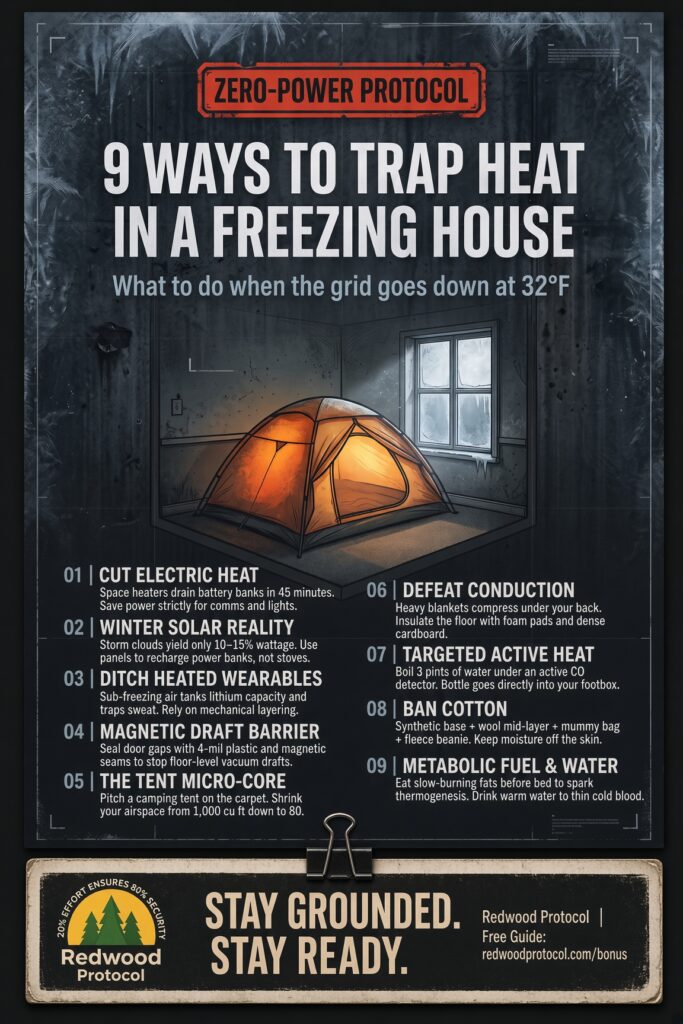
When an ice storm knocks out a regional substation and the neighborhood goes pitch-black for forty-eight hours straight, your standard suburban house turns on you. Modern drywall, engineered trusses, and subfloors don’t retain heat; they hemorrhage it. Within six hours, ambient indoor temperatures plunge toward the freezing mark, transforming concrete foundations into massive thermal heat sinks.
The average homeowner panics, grabs an oil-filled radiator, and drains an expensive solar generator in forty-five flat. Or worse, they drag a charcoal grill into the den and end up on the local evening news. Surviving a deep grid-down freeze isn’t about blowing thousands of dollars on tactical prepper gear—it’s about locking down basic physics, managing conduction, and shrinking your living footprint before your core temperature tanks.
1. Shrink the Airspace: The Micro-Core Solution
Heating a whole house with zero grid power is a mathematical dead end. Even a modest 10×10-foot bedroom holds roughly 800 to 1,000 cubic feet of stagnant, freezing air mass. A resting adult body radiates roughly 80 to 100 watts of thermal output. Put two adults and a kid together, and you have at most 250 watts of biological heat trying to fight cold-soaked sheetrock. You will lose that battle every single time.
The fix is simple: cut the volume you have to warm by ninety percent.
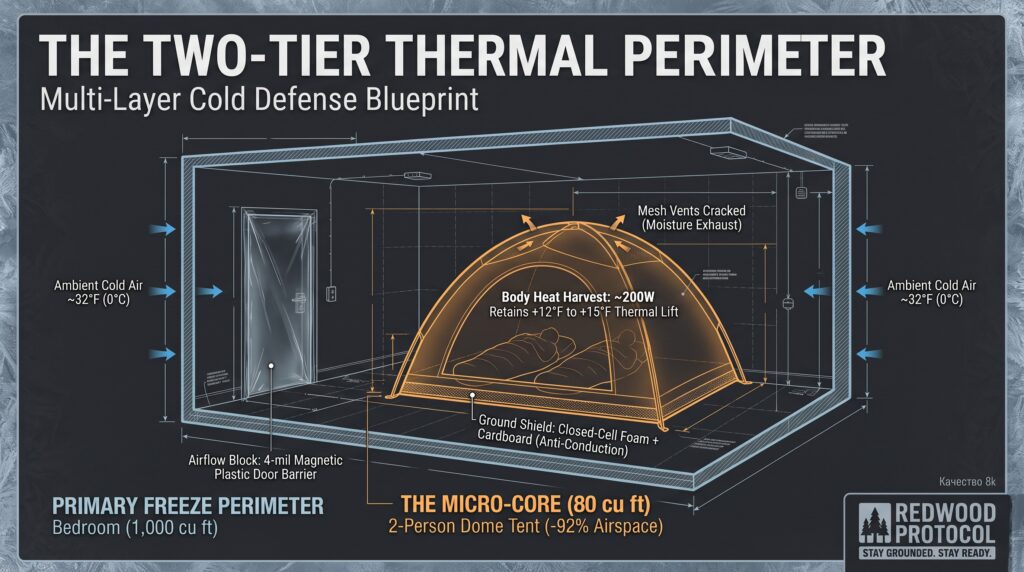
The Room Barrier: Pick a small, interior room without exterior corner walls or giant picture windows. Shut the interior doors, pull the blinds, and ditch the idea of stuffing old towels under the door crack. That floor-level gap pulls cold hallway drafts like a shop vac. Borrow a trick from drywall contractors: hang a 4-mil magnetic zip-wall or dust barrier across the doorway. It snaps shut on its own magnets every time someone steps through, holding in ambient warmth without pitching the room into total darkness.
The Micro-Core: Pitch a standard two- or three-person camping tent directly on the carpet. You just shrunk your thermal target from a thousand cubic feet down to an eighty-cubic-foot micro-dome. The trapped body heat and breath from two sleepers will easily push the interior tent temperature ten to fifteen degrees Fahrenheit above the ambient room.
Non-negotiable: Leave the ceiling mesh vents cracked open an inch. A sleeping body offloads roughly a pint of water vapor into the air through normal respiration overnight. If that moisture cannot escape, it condenses on the nylon rainfly, turns into ice-cold sleet inside the tent, and soaks your bedding.
2. Conduction is the Real Killer: Fix Your Ground Setup
Most people think cold air kills you. It doesn’t—conduction does. Heat transfers four ways: radiation, convection, evaporation, and conduction. Conduction is direct, kinetic heat theft from your warm skin into whatever cold surface you are touching.
Piling four or five heavy quilts on top of yourself while lying on a standard mattress is a fool’s errand. When you stretch out, your body weight crushes the mattress batting and blanket insulation down to a fraction of an inch. The dead air pockets vanish. That frozen mattress turns into a heat sink that drains thermal energy directly out of your back and kidneys all night long.
To stay warm, flip the equation: put more insulation under you than on top of you.
The Ground Shield: Throw down a closed-cell foam sleeping pad (like an old-school RidgeRest or blue gym mat) directly onto the tent floor. High-density closed-cell foam does not conduct heat and will not crush flat under your hips.
The Scrap Cardboard Hack: If you don’t have a camping pad, grab two layers of thick, corrugated cardboard shipping boxes from the garage. Corrugated cardboard creates a rigid, structural air gap that completely blocks cold concrete or hardwood floor transfer.
Top Layer: Lay a heavy wool blanket over the foam or cardboard before climbing into your sleeping bag.
3. The Cold-Weather Breakdown: Rookie Mistakes vs. Physics
| System / Vector | The Knee-Jerk Rookie Mistake | The Battle-Tested Physics Fix | The Science Behind It |
| Room Heating | Plugging space heaters into an inverter or battery generator. | Pitching an 80 cu ft tent in a sealed interior room. | A 1,500W heater eats a $1,000 power station in 45 minutes. An 80 cu ft tent holds 200W of human body heat and stays 15°F warmer. |
| Draft Sealing | Tucking towels under the door and hanging bedsheets. | 4-mil clear plastic magnetic dust barrier taped to frame. | Floor-level pressure differences pull freezing air at 1 ft/sec. 4-mil poly creates an airtight, see-through seal that closes itself. |
| Sleeping Base | Stacking five heavy comforters and blankets over your body. | Closed-cell foam pad or two layers of corrugated shipping boxes underneath. | Body weight squashes loft to zero, turning mattresses into thermal sinks. Rigid closed-cell foam will not compress. |
| Emergency Heat | Running kitchen stove burners, candles, or outdoor heaters inside. | Hot-water footbox bottle inside a wool sock + battery CO monitor. | Open flames silently dump deadly Carbon Monoxide ($CO$). A hot metal canteen in your sleeping bag footbox delivers safe, steady heat for 6–8 hours. |
| Sleep Layering | Wearing heavy cotton hoodies, flannel pajamas, and sweatpants. | Synthetic wicking base layers, wool mid-layers, loose wool socks, and a beanie. | Cotton traps moisture like a sponge; wet fabric bleeds heat 25x faster than dry air. Wool retains loft and warmth even when damp. |
| Bedtime Fuel | Snacking on cookies, candy, white bread, or sweet tea. | High-density fats: 2 tbsp peanut butter, walnuts, jerky, or grass-fed butter. | Sugar spikes insulin, constricts blood vessels, and causes a 2 A.M. shivering crash. Fats take 6 hours to break down via liver thermogenesis. |
| Hydration | Skipping water because you’re not sweating, or gulping ice water. | Sipping half a cup of warm water right before zipping into your bag. | Cold blunts thirst receptors by 40%. Dry air strips moisture via breath vapor; thick, dehydrated blood cannot reach your fingers or toes. |
4. The Footbox Warmer: Zero-Flame Overnight Heat
Open flames in a closed-up bedroom are lethal. Period. Charcoal briquettes, unvented kerosene torpedo heaters, and overnight gas burners consume oxygen and produce carbon monoxide. Carbon monoxide is tasteless, colorless, and odorless. It binds to your hemoglobin 200 times more aggressively than oxygen, knocks you out cold, and you don’t wake up.
If you burn camp fuel during an outage, you burn it for five minutes in a ventilated utility room or on the back porch to heat a thermal fluid—never the air you breathe.
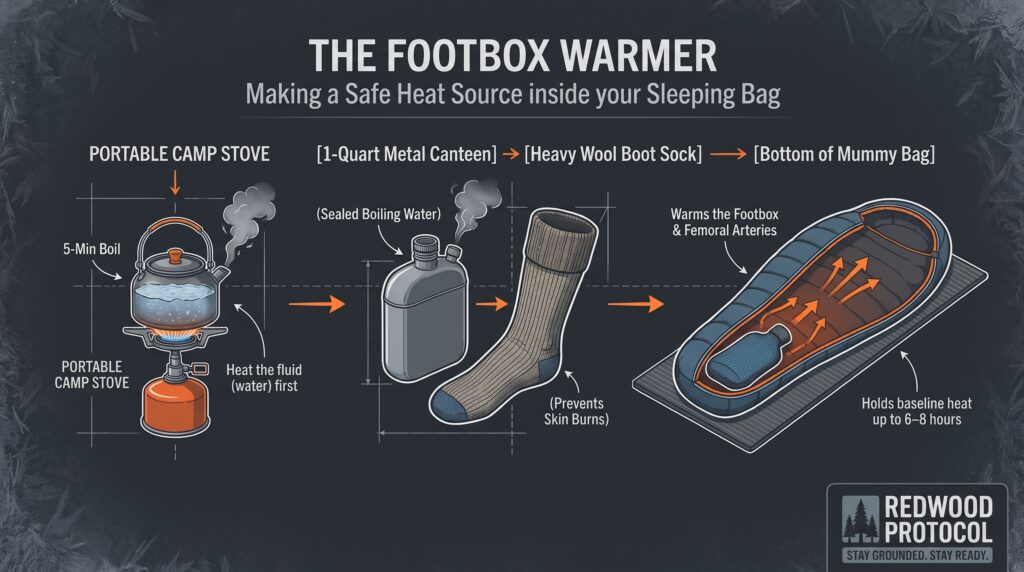
Boil and Fill: In a ventilated space, boil a quart of water on a small isobutane-propane canister stove. Pour it into a heavy-duty rubber hot-water bottle or a single-wall stainless steel/aluminum field canteen with a bulletproof gasket.
The Buffer Layer: Wrap the bottle in a thick wool boot sock. The wool regulates the heat transfer rate so you don’t scald your skin, stretching the thermal release across six to eight continuous hours.
The Footbox Placement: Slide that wrapped canteen down into the bottom of your sleeping bag. Your body pumps blood through the femoral and plantar arteries directly over that heat source, sending pre-warmed blood back up through your core all night long.
5. The 4:00 AM Metabolic Drop
Even with your perimeter sealed and your tent pitched, your circadian rhythm hits rock bottom around 04:00 AM. Core body temperatures drop naturally, blood pressure dips, and without fuel in the tank, violent shivering kicks in.
Your liver is the most efficient space heater in the room, but you have to feed it dense, slow-burning fuel.
The Sugar Trap: Junk carbs—cookies, processed snacks, soda—dump glucose into your bloodstream, trigger an insulin spike, and force peripheral vasoconstriction. Within ninety minutes, you crash hard, your blood vessels clamp down, and your toes go ice cold.
The Fat Protocol: Thirty minutes before racking out, eat two tablespoons of peanut butter, a handful of raw nuts, or some pemmican. Pure dietary fats deliver nine calories per gram and burn like hard anthracite coal. Your body works through that digestive breakdown steadily for five to six hours, keeping your vascular system open and warm through the coldest pre-dawn hours.
6. Cold-Weather Dehydration: The Sludge Factor
In freezing weather, your brain plays tricks on you. Peripheral vasoconstriction shunts blood volume toward your torso, tricking the kidneys and hypothalamus into thinking you are fully hydrated. Your thirst reflex shuts down by nearly forty percent.
At the same time, the dry air inside an unheated house pulls moisture straight out of your mucous membranes. Every puff of white vapor you breathe out dumps body water into the room.
When you dehydrate, your blood volume drops and blood viscosity spikes—turning it into sludge. Sluggish, thick blood cannot navigate the tiny capillary beds in your toes and fingers. You can wear three pairs of heavy merino socks, but if warm blood can’t reach your feet, those socks will just insulate cold flesh.
Keep an insulated thermos of warm, plain water next to your setup. Down half a cup before you zip up your sleeping bag. Warm fluid thins your blood, kicks peripheral circulation back into gear, and prevents your extremities from freezing while you sleep.
Would you like to generate the accompanying Pinterest video pins and SEO description package for this article, or format the text for your MailerLite newsletter broadcast?