
In modern video feeds, emergency preparedness always looks cinematic. A person in an immaculate tactical jacket kneels on dry pine needles, rhythmically working a bow drill. Within three minutes, under gentle ambient sunlight, an ember glows, tinder catches, and a pristine three-hundred-dollar fixed-blade knife rests proudly on a split log.
It looks capable. It looks disciplined. It collects millions of views.
Meanwhile, back in the real world, the municipal water pressure drops to zero. The refrigerator hums once and goes silent. Outside your window, it is not a sunny autumn forest—it is a sleet-soaked Tuesday evening in an urban or suburban neighborhood.
That three-minute edited clip is not an emergency protocol. It is theater. The camera does not record in freezing rain, the branches on screen are bone-dry, and the demonstrator’s fingers are warm and nimble. When the take fails, they cut the shot, turn on the studio heater, and reset.
A video take can be reshot. The dry tap in your kitchen cannot.
The Fatal Geographic Swap
The fundamental flaw in contemporary survival marketing is not that outdoor bushcraft skills are inherently useless; it is the dishonest substitution. The industry sells the fantasy of a wilderness trek with a heavy blade as a substitute for keeping your family safe when domestic infrastructure fails.
The overwhelming majority of households live in apartments, condos, and suburban subdivisions. When the regional grid collapses:
Nobody hikes into the timber to build a lean-to shelter. You stand in your hallway, trying to understand why the light switch no longer works.
The woods are not plumbed into your sink. If your municipal main loses pumping pressure or freezes, having an axe on your hip does not put a single ounce of potable fluid into your glass.
Suburbs are not softer than the city. A suburban front lawn is not an artesian well. A grocery store two blocks away is still a supply-chain dependent hub. When transport trucks stop running, the grass in your front yard does not become dinner.
True resilience begins by dismantling the three pervasive illusions that look impressive on video but leave your home defenseless.
Myth 1: Friction Fire Solves Everything
A dry spindle and hearth board can produce an ember under controlled conditions. But when ambient temperatures plunge, wet winter winds whistle through balcony railings, and cold-induced vasoconstriction makes your fingers stiffen within sixty seconds, friction fire becomes an exercise in futility.
Even if you achieve a dry spark, a spark is not boiling water. You require fine tinder, minutes of careful blowing, a windless staging area, and precise manual dexterity. Inside a modern apartment, attempting an open hearth on the floor is hazardous. On an apartment balcony, smoke and visible flame instantly advertise your domestic situation to every observer on the street.
The Protocol:
Keep the primitive fire skill as a personal discipline, but never list it as your household emergency plan. A realistic plan begins with a flame produced by a single finger click:
The Dual-Lighter Unit: Take two cheap, reliable disposable lighters (such as Cricket or classic Bic) and tape them together with electrical tape. If one jams or gets wet, the backup is already in your hand.
Dispersed Stashes: Do not store all fire sources in a single drawer. Place ten independent units across the perimeter: kitchen drawer, jacket pocket, family vehicle, emergency bag, bedside stand, and pantry shelf. Flame concentrated in one location disappears if that location is compromised.
Quiet Boiling: If you own a compact camp canister stove, treat it as an analog multiplier. It boils water silently and cleanly inside a ventilated kitchen without producing visible smoke or outdoor signatures.
The sober equation: Friction fire proves human endurance. A fifty-cent lighter boils water. When the grid fails, your family only needs the second.
Myth 2: The Wild Will Feed You
Survival shows promote the romance of foraging: edible cattail roots, wild berries, and fortunate small-game trapping.
In real life, a city lives on a 72-hour grocery shelf. As long as long-haul diesel trucks roll along interstate corridors, distribution remains invisible. The moment regional power collapses, those shelves strip bare in less time than it takes you to hike to the nearest municipal park.
By day three without freight deliveries, the local supermarket is not a resource—it is an empty building with shuttered doors and dead point-of-sale terminals. Foraging in populated suburban parks is an acute biological gamble: toxic lookalikes are easily mistaken for food by stressed, hungry people.
Furthermore, when the power grid fails, card readers and banking apps freeze immediately. A few small paper bills in your pocket do more to secure immediate rations in the first three hours than knowing how to identify a wild mushroom.
The Protocol:
Food for the first 72 hours must already sit inside your pantry before the incident occurs.
Store standard, non-perishable pantry staples your family already eats on an ordinary Thursday: canned proteins, whole grains, and foods that require minimal thermal energy to prepare.
Calculate food in complete operational days, not random cans. Three balanced meals plus the exact water volume required to hydrate and cook them.
If nobody in your house touches a specific canned item during normal life, it does not become an appetizing meal during a crisis. It becomes dead weight.
Myth 3: The $300 Combat Blade
This illusion generates the highest profit margins. Pristine coated steel, military-grade sheaths, and rugged bug-out bags dominate social feeds. Marketing convinces you that without expensive tactical gear, you are fundamentally unprotected.
The blade in the catalog looks flawless because your real emergency is not in the frame. The advertisement does not show your children waiting in a dark living room, a frozen pipe, or a dry faucet. A knife performs exactly one physical job: it cuts. It cannot quench thirst, it cannot illuminate a windowless corridor, and it cannot store paper contact numbers when your smartphone battery dies.
A three-hundred-dollar knife covers one single line on a preparation checklist while ignoring every critical vulnerability around it.
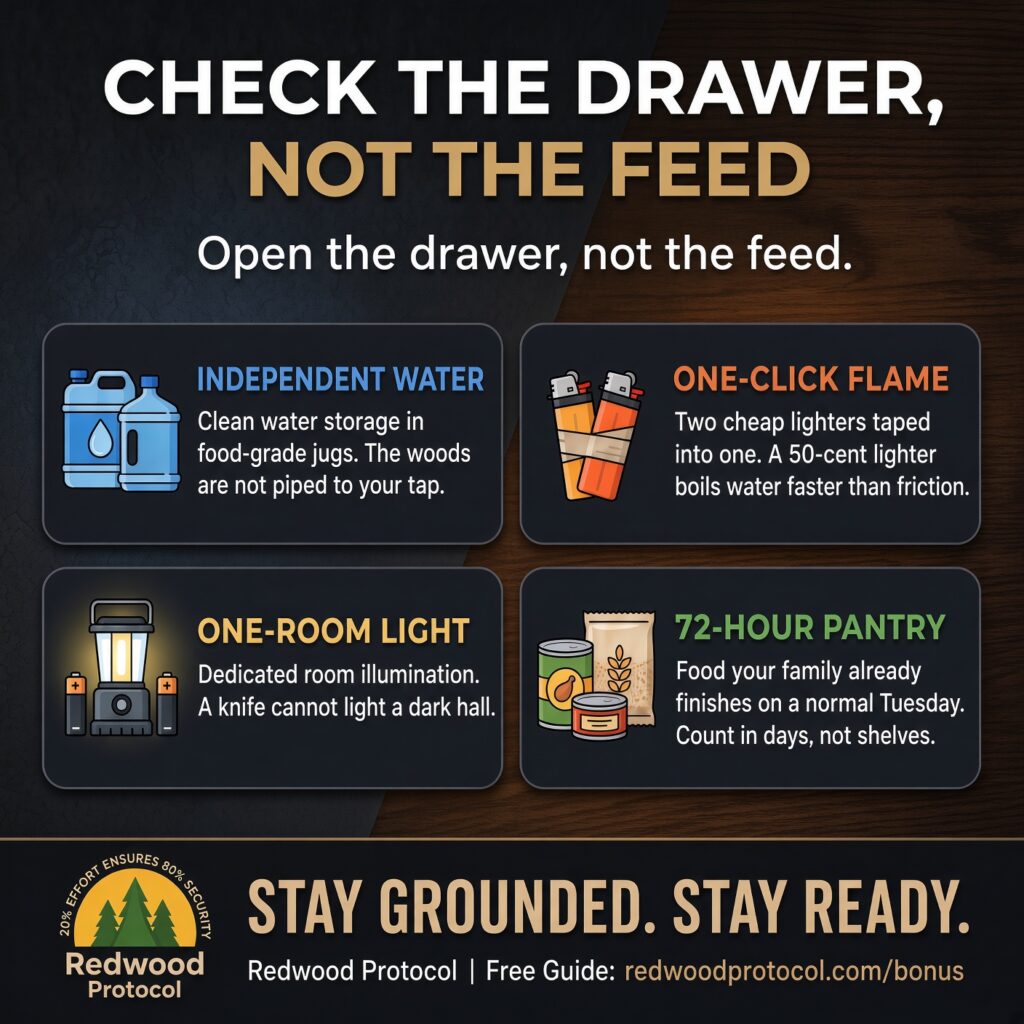
The home perimeter is not defended by what is strapped to your belt; it is measured by the gaps inside your physical space:
No stored water when the valve shuts.
No illumination in the central living area.
No thermal source to boil water without electricity.
No analog, paper directory when networks drop.
Two hundred dollars invested in basic food-grade water containers, durable flashlights, extra alkaline batteries, reliable lighters, basic manual tools, and simple shelf-stable food will safeguard a family indefinitely longer than a collector’s combat blade.
The Signature Problem: The Value of a Low Profile
There is another operational reality the camera never discusses: an open fire in an apartment courtyard or suburban driveway is an active beacon.
Thick smoke rising past balconies, dancing light against brick walls, and crowded outdoor congregation attract immediate attention. A quiet home with closed curtains, adequate stored water, and a dim, warm lantern operating in a single interior room is invisible from the street.
The same principle applies to bug-out preparations. Frantic packing on a front porch broadcasts distress across the neighborhood. Stored water inside a kitchen cabinet makes no sound. Preparedness is not a performance; it is the quiet absence of panic.
The Baseline Inspection: Open the Drawer
Do not judge your household readiness by the bookmarks in your social feed. Put down the screen and open your kitchen drawer:
Water: Is there clean water stored in food-grade vessels independent of the municipal main?
Flame: Are there multiple analog fire units that spark with a single finger touch—no friction, no complex adjustments?
Light: Is there dedicated area lighting and spare batteries ready in an accessible spot?
Pantry: Are there 72 hours of familiar, shelf-stable calories that require zero long-term boiling?
If those foundational gaps are open, do not buy another blade. Buy what fills the gaps.
Twenty percent of disciplined, foundational habits guarantee eighty percent of your family’s real-world security.