When planning for sustained disruptions to municipal infrastructure, standard preparedness doctrine focuses almost exclusively on caloric density: pounds of polished white rice, dried pinto beans, rolled oats, and multi-decade freeze-dried rations.
While macro-calories prevent immediate starvation, a diet composed exclusively of preserved, heat-treated, and dehydrated shelf-stable rations creates a severe, invisible vulnerability: cellular malnutrition, historically documented as the Scurvy Trap.
Within 30 to 60 days without fresh, bioavailable micronutrients and living enzymes, the human body begins a quiet systemic decline. Connective tissue degrades, immune function collapses, mental acuity deteriorates under oxidative stress, and minor lacerations fail to heal.
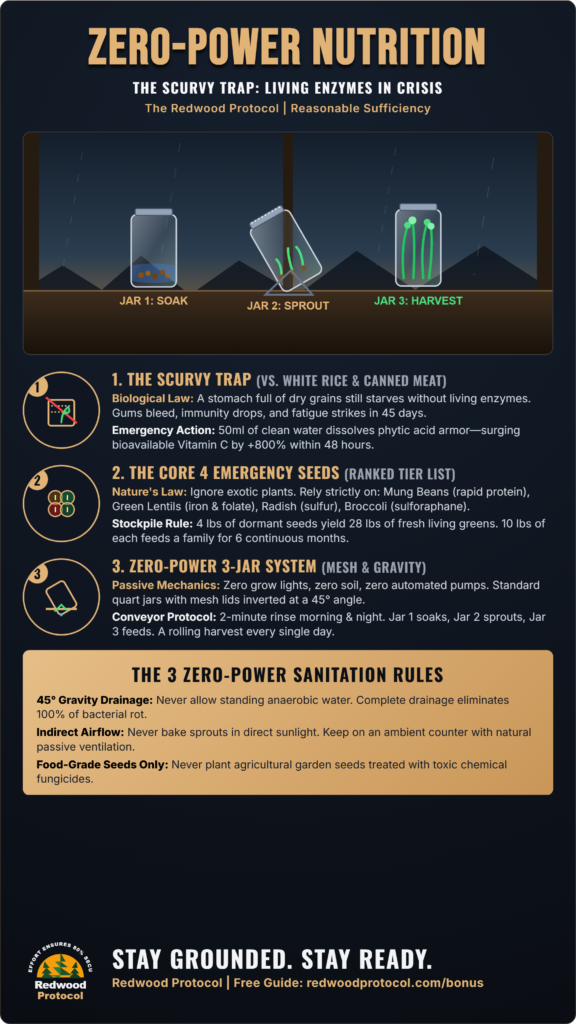
This technical guide provides the biological rationale, nutritional chemistry, and operational protocol for operating a Zero-Power 3-Jar Continuous Sprouting System—yielding a perpetual daily supply of living, enzyme-dense greens using passive gravity, ambient air, and minimal water.
1. The Biochemistry of “Dead” Rations vs. Living Sprouts
The Dormancy Defense Mechanism
In its dry, dormant state, a seed or legume is an enclosed genetic fortress. To survive years in soil without prematurely germinating or rotting, seeds are saturated with chemical armor designed to deter consumption:
- Phytic Acid (Inositol Hexaphosphate): A potent chelator that binds tenaciously to essential minerals—principally Zinc (Zn2+), Magnesium (Mg2+), Iron (Fe2+), and Calcium (Ca2+)—within the human gastrointestinal tract. Bound minerals cannot cross the intestinal wall and are excreted unabsorbed.
- Enzyme Inhibitors (Trypsin & Chymotrypsin Inhibitors): Protein structures that neutralize human digestive enzymes, causing metabolic strain, incomplete protein assimilation, and chronic gut inflammation.
- Complex Oligosaccharides (Raffinose & Stachyose): Undigestible sugar chains that ferment anaerobically in the lower colon, leading to gas, cramping, and gastrointestinal distress during high-stress survival scenarios.
The Awakening Reaction
When dormant seeds are submerged in clean water for 8 to 12 hours, water penetrates the seed coat (testa), initiating enzyme hydration.
Endogenous phytase enzymes activate, rapidly dismantling phytic acid molecules into free, bioavailable inositol and soluble phosphates. Simultaneously, dormant storage proteins break down into easily absorbable free amino acids, and vitamin synthesis cascades exponentially.
Nutritional Transformation Table
| Metric | Dormant Seed (Dry) | Sprouted (72–96 Hours) |
|---|---|---|
| Vitamin C Concentration | Near 0 mg / 100g | 20 – 45 mg / 100g (+800% surge) |
| Phytic Acid (Anti-nutrient) | High (Blocks mineral absorption) | Degraded by 70% – 90% |
| Bioavailable Protein Assimilation | Moderate (35% – 45%) | High (80% – 90% free amino acids) |
| Active Digestive Enzymes | Dormant / Inhibited | Peak synthesis active |
| Antioxidant & Bioflavonoid Density | Base baseline level | 300% to 1,200% increase |
| Cooking Fuel Requirement | 30–60 min active boiling | Zero (100% edible raw) |
| Water Needed for Digestion | High metabolic demand | Hydrating and fiber-dense |
2. Comprehensive Nutritional Comparison Table
The following matrix contrasts standard non-perishable survival staples against active sprouted crops across critical survival markers:
| Food Category | Caloric Density (per 100g) | Vitamin C (mg) | Bioavailable Iron (mg) | Active Living Enzymes | Shelf Life Prior to Activation | Water Needed for Preparation |
|---|---|---|---|---|---|---|
| White Rice (Polished) | 365 kcal | 0.0 mg | 0.8 mg | None (Processed) | 25+ Years | 200 ml + 20 min Fuel Boil |
| Pinto Beans (Dry Raw) | 347 kcal | 0.0 mg | 5.0 mg (Low Bio) | Inhibited | 10–15 Years | 400 ml + 60 min Fuel Boil |
| Canned Rations (Meat/Stew) | 180–240 kcal | < 2.0 mg | 1.5–2.5 mg | Destroyed (Heat Retort) | 3–5 Years | 0 ml (Ready to eat) |
| Sprouted Mung Beans | 30 kcal | 32.0 mg | 2.5 mg (High Bio) | Maximum Active | 5–7 Years (Dry Seed) | 50 ml Passive Rinse |
| Sprouted Green Lentils | 106 kcal | 16.5 mg | 3.1 mg (High Bio) | Maximum Active | 5–8 Years (Dry Seed) | 50 ml Passive Rinse |
| Sprouted Daikon Radish | 43 kcal | 29.0 mg | 1.2 mg | Maximum Active | 4–5 Years (Dry Seed) | 40 ml Passive Rinse |
| Sprouted Broccoli | 35 kcal | 51.0 mg | 1.3 mg | Peak Sulforaphane | 3–5 Years (Dry Seed) | 40 ml Passive Rinse |
3. The Core 4 Emergency Seeds Ranked
In an austere off-grid environment, seed selection must prioritize high biomass expansion, absolute reliability, resistance to pathogens, and rapid harvest windows (under 5 days).
1. Mung Beans (Vigna radiata) — The Protein King
- Growth Cycle: 72 to 96 hours.
- Biomass Expansion: 1 tablespoon dry (~15g) yields nearly 1 full cup of dense, crunchy sprouts (~120g).
- Nutritional Role: Delivers 24% highly digestible plant protein by dry weight. Exceptional source of potassium, magnesium, and bioavailable folate.
- Tactical Asset: The most durable and forgiving seed for beginners; tolerates temperature swings from 15°C to 28°C without stalling.
2. Whole Green Lentils (Lens culinaris) — The Caloric Workhorse
- Growth Cycle: 48 to 72 hours.
- Biomass Expansion: 1:6 expansion ratio.
- Nutritional Role: High concentrations of non-heme iron paired directly with endogenous vitamin C generated during sprouting, dramatically accelerating human red blood cell production.
- Tactical Asset: The fastest ready-to-consume crop. By hour 48, when the small white tail emerges, lentils can be eaten raw without stomach upset.
3. Daikon / Red Radish (Raphanus sativus) — The Respiratory Guard
- Growth Cycle: 4 to 5 days.
- Biomass Expansion: 1:8 expansion ratio.
- Nutritional Role: Exceptionally high in glucosinolates and natural sulfur-bearing isothiocyanates.
- Tactical Asset: Provides a sharp, spicy bite that stimulates salivary and gastric acid secretion, relieving sinus congestion in unheated, damp shelter environments.
4. Sprouting Broccoli (Brassica oleracea var. italica) — The Cellular Fortress
- Growth Cycle: 5 to 6 days.
- Biomass Expansion: 1:10 expansion ratio.
- Nutritional Role: The world’s richest known dietary source of glucoraphanin, the precursor to sulforaphane.
- Tactical Asset: Contains 20 to 50 times the concentration of sulforaphane found in mature supermarket broccoli heads. Sulforaphane activates the human Nrf2 genetic pathway, driving Phase II liver detoxification—vital when filtering contaminated air, smoke, or water.
4. Engineering the System: The Zero-Power 3-Jar Protocol
The Redwood Protocol sprouting architecture requires zero electrical input, zero artificial grow lamps, and zero soil mediums. The entire process relies on controlled hydration, gravity-assisted drainage, and passive airflow.
Essential Field Equipment
- 3x Wide-Mouth 32 oz (1-Quart) Glass Mason Jars: Smooth glass provides a non-porous, easily sterilized surface that prevents bacterial anchoring.
- 3x 316 Stainless Steel Mesh Lids (30-40 Mesh): Resists corrosion from daily moisture exposure.
- 1x Angled Draining Tray or Rack: Critical for maintaining an exact 45-degree angle of rest.
- Potable, Non-Chlorinated Water: Rainwater (filtered), spring water, or dechlorinated well water.
Operational Procedure
Step 1: Sanitation & Initial Hydration (Hour 0 to 12)
- Thoroughly rinse Jar 1 with boiling water.
- Measure 2 level tablespoons (approximately 20–25g) of dry seed into the jar.
- Fill the jar halfway with clean, room-temperature water.
- Fasten the stainless mesh lid and store in a dim ambient corner (18°C–22°C) for 8 to 12 hours.
Step 2: The Inversion Protocol (Day 2)
- Tip Jar 1 upside down over a sink or basin, draining all soaking liquid completely.
- Place the jar face down into the rack at a strict 45-degree downward angle.
- Fluid Dynamics Rule: The seeds must form a thin layer along the slanted glass wall rather than a dense, suffocating clump across the mesh screen. Air must travel passively up through the screen and circulate throughout the jar interior.
Step 3: The 30-Second Maintenance Rinse (Days 2 to 4)
- Every morning and evening (every 10–14 hours), pour 150 ml of cold water directly through the mesh screen.
- Gently swirl the water inside the jar for 4 to 5 seconds to rinse metabolic byproducts and residual starches away from the growing roots.
- Invert and drain thoroughly until no water drips from the mouth, then return to the 45-degree angled stand.
Step 4: The 72-Hour Perpetual Conveyor
- Day 1 (Morning): Hydrate Jar 1 (Mung Beans).
- Day 2 (Morning): Drain Jar 1 -> Hydrate Jar 2 (Lentils).
- Day 3 (Morning): Rinse Jars 1 & 2 -> Hydrate Jar 3 (Radish or Broccoli).
- Day 4 (Morning): Harvest Jar 1 completely for consumption. Wash Jar 1 and reload with fresh dry seeds.
This continuous three-tier staging ensures that while one jar is consumed, the second is mid-growth, and the third is breaking dormancy—generating a reliable harvest every 24 hours.
5. Critical Biohazard & Sanitation Protocols
In an austere survival scenario, gastrointestinal distress caused by bacterial contamination can rapidly lead to fatal dehydration. Sprouting creates a warm, moist micro-climate that requires strict adherence to three safety parameters:
1. The Anaerobic Moisture Trap (Mold Prevention)
- The Failure: Storing jars flat on their base or with inadequate tilt angles causes water to pool around the bottom seeds.
- The Mechanism: Standing water cuts off oxygen, triggering rapid anaerobic fermentation and the growth of Aspergillus mold and Enterobacter bacteria within 24 hours.
- The Fix: Always maintain the 45-degree downward tilt. If a jar produces a sour, fermenting alcohol odor or visible web-like mold structures, discard the batch entirely and sanitize the glass with boiling water. (Note: Do not confuse white fuzzy root hairs with mold. Micro-root hairs disappear upon contact with water during rinsing; mold does not.)
2. Thermal Management (Bacterial Spikes)
- Avoid placing sprouting jars in direct sunlight or adjacent to woodstoves and radiators.
- Direct solar radiation creates a greenhouse effect inside the glass, elevating internal jar temperatures above 30°C—the ideal reproductive zone for Salmonella and E. coli.
- Always sprout in indirect, shaded ambient room light.
3. Commercial Seed Contamination (Fungicide Coatings)
- Standard seed packets purchased from commercial agricultural or gardening centers are frequently treated with chemical anti-fungal powders (such as Captan or Thiram) and synthetic color coatings.
- These systemic chemical compounds are toxic to human ingestion.
- Mandate: Stockpile exclusively certified food-grade, organic, high-germination sprouting seeds.
6. Strategic Logistics: Long-Term Stockpile Planning
To calculate seed requirements for a self-sufficient protocol, utilize this operational planning table based on 1 adult male ration (20g dry seed / day -> ~140g fresh greens / day):
| Timeframe | Dry Seed Requirement (Mung/Lentils) | Daily Living Biomass Output | Vitamin C Generated | Total Storage Volume |
|---|---|---|---|---|
| 30 Days (1 Person) | 600 g (1.3 lbs) | ~4.2 kg fresh greens | ~960 mg | Single 1-Quart Jar |
| 90 Days (1 Person) | 1.8 kg (4.0 lbs) | ~12.6 kg fresh greens | ~2,880 mg | Half Gallon Mylar Bag |
| 180 Days (1 Person) | 3.6 kg (8.0 lbs) | ~25.2 kg fresh greens | ~5,760 mg | Single #10 Can |
| 90 Days (Family of 4) | 7.2 kg (16.0 lbs) | ~50.4 kg fresh greens | ~11,520 mg | One 2-Gallon Bucket |
7. Field Integration: Preserving Living Enzymes
To maximize physiological benefit, never boil, fry, or cook your fresh sprouts at high temperatures. Heat denatures the delicate ascorbic acid and deactivates active phytase and sulforaphane enzymes.
- Primary Consumption Method: Consume sprouts raw as a crisp side ration alongside rehydrated dry beans and rice.
- Hot Meal Integration (The “Cold Fold”): If adding sprouts to hot survival stews or rehydrated pemmican, remove the pot from the heat source and allow it to cool below 45°C (comfortable to touch) before folding the sprouts in. This preserves crunch, texture, and active enzymatic structures.
Conclusion
A comprehensive survival plan is not judged by the raw gross weight of food in your cellar, but by its biological bioavailability. Dead calories sustain basic basal metabolic output for a limited window; living micronutrients sustain cellular repair, immunity, and cognitive clarity indefinitely.
By dedicating a minimal footprint in your storage for glass jars, stainless mesh, and durable food-grade sprouting seeds, you secure an inexhaustible, off-grid bio-foundry capable of supporting human vitality through any prolonged crisis.
- Save this quick-reference infographic to your phone for offline kitchen use: